When the Teacher Sat Down — Hearing the Beatitudes for the First Time (Matthew 5:1–12)
Why Jesus’ opening words were far more shocking and beautiful than we realize

Editor’s Note:
This post is part of the ongoing Matthew in Context series, where we explore the Gospel of Matthew through its first-century lens. Today begins a special three-part mini-series on the Beatitudes (Matthew 5:1–12). Over the next two posts, we will walk through each blessing Jesus pronounces and recover their original depth, force, and beauty.
A Familiar Passage That Has Lost Its Edge
The Beatitudes are among the most recognized and recited words Jesus ever spoke. They are quoted in chapel services and stitched on wall art. They are the kind of words we think we understand because we have heard them so many times. Yet the familiarity of the Beatitudes has quietly stolen their power. What once landed like a lightning bolt on the hills of Galilee now feels like a gentle breeze to modern ears. If we want to hear these blessings the way the first disciples did, we have to go back to the mountain. We have to sit with Jesus as they did. And we have to let Him surprise us again.
Jesus Goes Up the Mountain
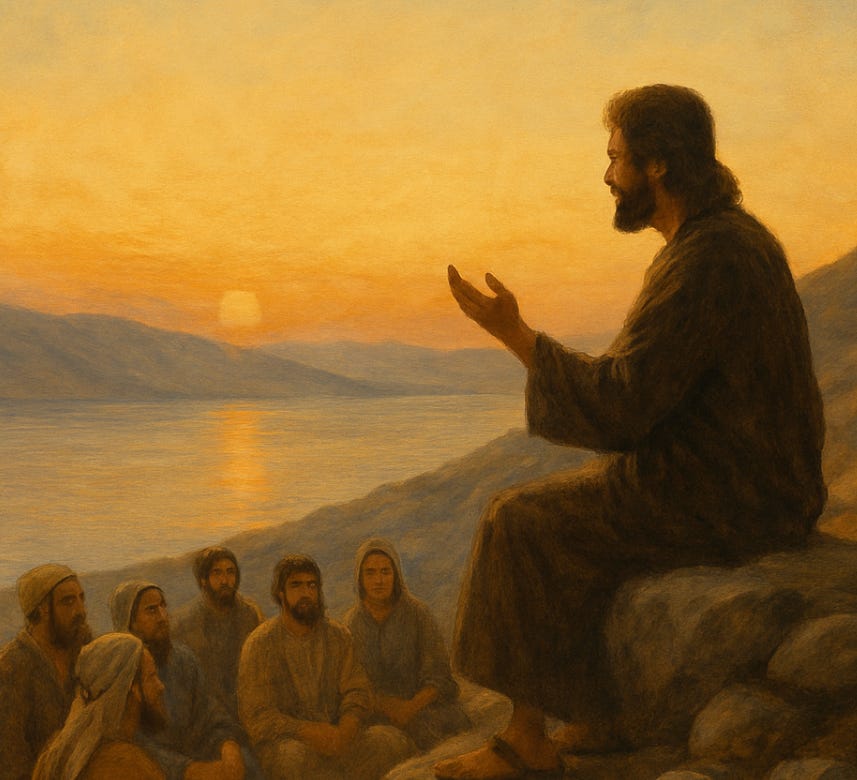
Matthew tells us that when Jesus saw the crowds, He went up on the mountain and sat down, and His disciples came to Him (Matthew 5:1). This may seem like a simple scene, but for first-century Jews it was charged with significance. In Matthew’s Gospel, mountains are not backdrops. Mountains are places where God reveals Himself. Abraham ascended a mountain to prove his trust in God. Moses received the Torah on a mountain. Elijah heard the whisper of God on a mountain.
When Jesus goes up a mountain and begins to teach, Matthew is showing us something profound. Jesus stands in the line of Moses, yet He is greater than Moses. He is not receiving a law. He is giving one.¹
The Teacher Sits Down
And then Jesus sits. Rabbis stood to read Scripture but sat to interpret it. The sitting posture was the seat of authority.² When Jesus sits, He is taking the authoritative position of the true Teacher of Israel. His disciples gather close. These are those who have already said yes to His call, who have left everything to follow Him. This moment is not for the curious crowds. It is for those who have committed themselves to the way of the Kingdom.
This matters because the Sermon on the Mount is not a list of moral ideas for the general public. It is the formation manual for Jesus’ disciples. It is the blueprint for Kingdom identity. And Jesus begins this formation not with commands or demands but with blessing. Before He teaches His disciples what life in the Kingdom looks like on the outside, He begins by shaping who they are on the inside.
Blessing Before Command
This is why the Beatitudes cannot be understood as commands. No first-century listener would have heard them that way. Jesus is not telling His disciples to try harder to be meek or to force themselves to mourn. He is not inviting them to perform certain virtues in order to earn spiritual approval. He is describing the kind of people God blesses and the kind of people God is already forming through His reign.
The Meaning of “Blessed”
The word He uses for “blessed” is makarios. Many English translations render it “happy,” but that is far too small. In Greek literature, makarios described the condition of flourishing enjoyed by the gods, a state of life that cannot be shaken by the circumstances of the world. In the Old Testament, the Hebrew equivalent, ’ashrei, was used to describe the deep joy of those who walked in alignment with God’s will.³ Makarios is not about emotion. It is about divine approval. It is God’s declaration over a person’s life.
When Jesus opens His sermon with “Blessed are…,” He is not making suggestions about how to feel. He is revealing who is already living under the smile of God. He is announcing that those who seem overlooked by the world are honored by heaven. And He is inviting His disciples to see blessing through the lens of the Kingdom rather than the lens of their culture.
A Kingdom That Reverses Expectations
This was absolutely stunning to those who first heard it. In the ancient world, blessing was often associated with wealth, strength, honor, and victory. Blessed were the powerful. Blessed were the wealthy. Blessed were the successful and the influential. Yet Jesus opens His teaching by declaring blessing on the poor in spirit, the mourners, the meek, and the hungry. These are not the categories of worldly success. They are the categories of human need.
This means something vital for us today: the Beatitudes are not about performing. They are about becoming. They do not call us to produce something for God. They call us to receive something from Him. They describe the inner landscape of a disciple who is being formed by grace. They show us what kind of heart is able to live the life Jesus will describe in the rest of the Sermon on the Mount.
A Life Shaped by Grace, Not Striving
If we misunderstand the word “blessed,” we will misunderstand the entire sermon. The life Jesus calls us into is not the result of striving. It is the fruit of surrender. It comes not from achieving spiritual virtue but from receiving the transforming presence of God. The Beatitudes reveal the kind of person God shapes in us when His Kingdom draws near.
In the next post, we will walk into the first four Beatitudes. These blessings form the inner foundation of the Kingdom life. They describe the heart that grace begins to cultivate. And they show us that the way into God’s Kingdom begins not with strength but with need, not with achievement but with dependence.
Footnotes
¹ Dale C. Allison Jr., The New Moses: A Matthean Typology, 181–205.
² Craig S. Keener, The Gospel of Matthew: A Socio-Rhetorical Commentary, 160.
³ Jonathan Pennington, The Sermon on the Mount and Human Flourishing, 41–44.